Off-Grid Solar Reality Check
Why Your Caravan Batteries Don’t Charge All Day
Heading off-grid in one of our vans is all about freedom—pulling up at a quiet National Park, a remote Hipcamp paddock, or a tucked-away spot on the MidCoast without relying on powered sites.
Because our vans come kitted out with serious solar and lithium setups, it’s easy to assume that as long as the sun is up, your batteries are pumping back to 100% in a couple of hours.
In reality, solar doesn’t work quite like plugging into a wall socket at home. Here’s what actually happens on the roof during a typical day in the bush—and how to keep your power sorted so you can keep living it up.
The Shade Trap: 12 Hours of Daylight ≠ 12 Hours of Charging
When you look at the sky, you might see 11 to 14 hours of daylight. Naturally, you think, "Beauty—plenty of sun to top up the batteries."
The catch? Trees.
When you park in a grassy paddock or under a nice shady gumtree (because nobody wants their van baking in 35-degree heat), that tree’s shadow moves across your roof as the sun tracks from east to west.
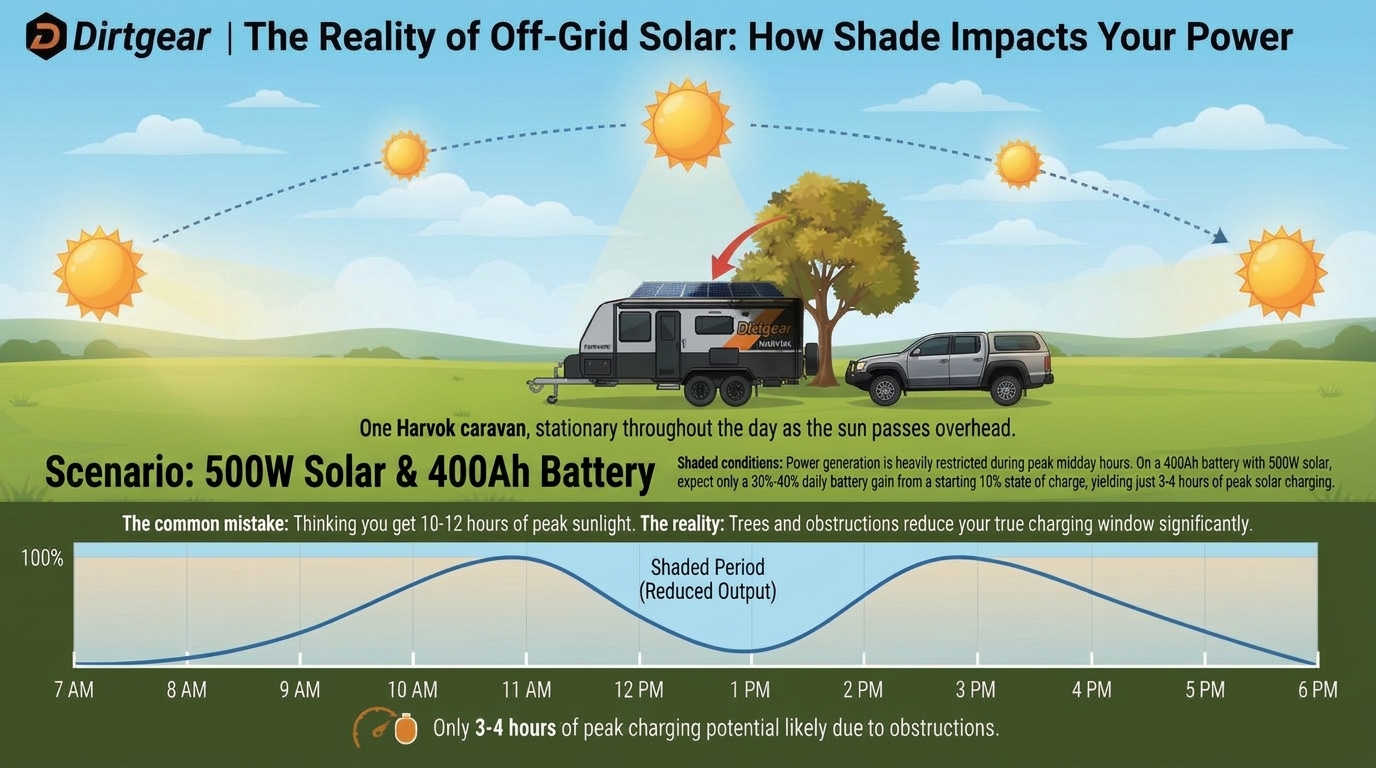
As shown in our infographic and animation above:
Morning Sun (7:00 AM – 9:00 AM): The sun hits the panels cleanly at a low angle, giving you strong early efficiency (85%–100% of potential output for that sun angle).
Midday Shade Dip (11:00 AM – 2:00 PM): Right when the sun is strongest overhead, a single tree branch or canopy blocking your roof can slash your solar input down to 10%–30%. Even partial shade across one section of a panel can drag down the whole array.
Afternoon Sun (3:00 PM – 5:00 PM): Once the sun clears the tree, output picks back up into the 40%–60% range before naturally tapering off as the sun drops toward evening.
Instead of a full day of peak charging, obstructions often leave you with only 3–4 hours of solid, high-output charging.
Let’s Do the Real-World Maths: 400Ah Battery + 500W Solar
To put that into perspective, let’s look at a common off-grid setup: a 400Ah lithium battery bank paired with 500W of roof solar.
Total battery capacity: A 12V 400Ah battery holds 400 amp-hours (about 4.8kWh to 5.1kWh of energy).
Ideal solar output (no shade, peak sun): A 500W solar system in ideal midday conditions produces roughly 30 to 35 amps per hour (accounting for real-world heat and MPPT controller losses).
What happens on a shaded day (like the infographic):
During your 3–4 hours of clear charging windows, you might pull in around 30A × 3.5 hours = ~105Ah.
During the shaded midday stretch and low-angle morning/evening hours, trickle charging might add another 15Ah–25Ah.
Total gained over the whole day: Roughly 120Ah to 130Ah—and that’s before subtracting what your fridge, lights, water pump, and devices are using while the sun is up (which can easily eat 30Ah–50Ah during the day).
The result? If you start the morning at 10% battery, a full day parked near trees with 500W of solar won’t take you to 100%. After running your fridge and daily essentials, you’ll likely finish the day sitting around 30% to 40% (or roughly 40%–42% max if you barely touch a switch all day).
4 Quick Tips to Keep Your Power Topped Up Off-Grid
You don’t need to stress about power—you just need to camp smart:
Watch the Sun Path When You Park: Before unhitching and dropping the stabilisers, look up. Check where the trees are to the north and west—that’s where the sun will be during the prime charging hours.
Park in the Sun, Sit Under the Awning: Leave the van out in the open where the roof panels get clean sky, and roll out the awning (or set up a gazebo) for your own shade.
Save Heavy 240V Loads for Sunny Windows: Running the coffee machine, induction cooktop, or hairdryer through the inverter draws big amps fast. Save those for when the sun is hitting the roof cleanly, or use the gas cooktop instead.
Top Up While You Drive: Going for a day trip to explore the coast or hit a local lookout? Driving charges your van’s batteries via the vehicle’s DC-DC charger, giving you a healthy boost before you even get back to camp.